

07 Mar A Conversation with Kyla Dante by Lissie Cowley
This blog was originally posted on the Lissie Cowley blog.
The Earth’s immune system has been triggered

The Artist spends her time between the great outdoors and the studio, working with natural materials outdoors and oil paints in her studio

L: I attended your exhibition back in April. The choice of your venue- an old church, must of no doubt enhanced the sound element of your performances. Your artwork spans across many mediums so that it is multi-sensory. Why did you choose to make sound a key element of your work?
K: Sound plays a large part in my creative process. Sound both influences the making of the piece and then the delivery. Creating a cross sensory experience can tell more of a story and reach a broader audience while at the same time fusing a common resonance between all involved. Sound is effective at moving through barriers that people have built to cope with being continually bombarded with stimuli. Here sound is used to ease people and invite them to remain within the space and connect with the experience rather than to quickly pass through.
L:How do you think the cross sensory experience conveys the message of your work?
K: The message of ‘connectedness’ to each other and the earth, and our awareness of our environment, were repeatedly reinforced (in Echoes of a Spiritual nature) by powerful visual images, light projections, music and spoken word. These continually evoke strong emotional responses whilst hopefully leaving enough space for the viewer’s internal library of memories and their own story to develop. Inviting people to touch the work and carry small handheld sculptures I find is also effective in fostering participation, creating an inclusive environment.
The message of some of the large earth manuscripts tend to echo the multi-layers of what’s going on under our feet. The canvases are like portals. I hope to convey this presence of nature through the very materials in the ground. I want people to stand in front of the canvas and have a memory tickled – a feeling of an ancient belonging (to the earth) in a time when a lot of us feel really disjointed and don’t have any way of knowing where we belong.

L: You used pre-recorded sounds of both natural and the urban environment, what was the reason for combining sounds from two very different landscapes?
K: I worked with Mick Berry (Bez) to make recordings that would describe the story of our evolution through sound. We used recordings from vast moorland spaces and the Pennines, echoing the shapes and surfaces in the natural landscape and the animal voices present. Then the sounds move to a busier, chaotic soundscape, with roaring machinery, traffic congestion, interference through radio transmitters, and mobile masts. The pace moves quicker and quicker, speeding endlessly towards where? …To the beginning?
The sound library is about stimulating the senses using both familiar and unfamiliar noises that evoke a progression through time. Sacred song, chant and reverence appear a long that line of sound and then fade again, taken over by chaos. This combination of sounds is about where we have come from, where we are now, and where we can go.
L: Why do you choose to make artwork that is socially and environmentally motivated?
K: To embrace our differences and our diversity through art and creativity and empower as many as possible through enriching experiential exhibitions and performances.
In creating art we are given a billboard to say what we want to the world and are fortunate to have a voice. The freedom we have in the West to follow a creative practice is an honour, to use that to promote wellbeing and connectivity in fractured times is a way I can try and influence peoples’ perspectives.
L: How do you aim to create social change in attitudes to the environment using artwork?
K: People feel a sense of vitality when faced with a large landscape or the beauty of the sky. The in-take of breath we experience when faced with the natural world is instantly medicinal to many and allows a space within the mind for new ways of thinking. I aim with my work to bring that feeling to the exhibition space as a reminder of what we are part of and where we come from. This then fosters a respect and reverence for the earth, which is greatly needed in a time when our natural systems and resources are threatened.

L: You describe the earth as being sick, what inspired this idea?
K: Someone close to me said they felt that the earth’s immune system had been triggered and the natural disasters and extreme weather events were a response to us humans becoming like a cancer to the earth. The earth is a living system and is trying to survive the onslaught and extraction of important elements. I feel that as our connection to the natural world is severed further and the cause and affect of our actions has not been observed then things can only get worse. With the pursuit of personal success, money and gain becoming more important than community, family and the environment it gives us great cause for concern that the route we are taking will lead to more isolation from fellow competitors (in this human race to nowhere) making people feel separate, angry and unable to thrive. In the end there is no plan B as there is no Planet B!
L: Do you think that more artists should be concerned with environmental issues? Why/Why not?
K: Artists are drawn to work with what is relevant to their creative path and life experience. I found it interesting when I heard a comment in an interview with a curator of how few contemporary artists were really dealing with the strong issues we are faced with in the world. There was a comment that this had something to do with the continual bombardment by media and over stimulation through screen observation of overwhelming subject matter and we have become less sensitive. We are continually observing problems that are less local to us so further removed from our everyday experience. As artists we need to experience and research our topics first hand. I find artists need to take on the role of the researcher to deliver appropriate information.

L: The passage of time is an important part of your practice, especially with the immersed or buried canvases. I am interested in stepping back and letting nature do the work, is this process designed to send out a wider social message? How/Why?
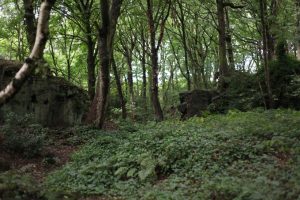
K: We need to listen more is probably the message. To stop and listen to what is already there, to allow the land to speak. Working in this way helps me connect with the landscape, helps me not want to pursue and conquer with my paintbrush but be an ear to the natural systems that surround us. Always without fail with the canvas, there is this beautiful echo of what you see visually then what is absorbed, it’s very map-like.

A river piece submerged

Close up detail of River Piece – Kyla Dante
Do you know what a Sundog is? ‘Sundogs’ form, often in pairs when sunlight refracts through icy clouds. It is a beautiful atmospheric phenomena that looks like there is two suns – but you’ll be amazed at how many people miss it because they never look up. I look around and I see most peoples’ faces glued to a phone screen. My artwork aims to encourage people look up and look around
L: Pollution is a serious problem in our watersheds and on our land, day to day do you encounter signs of polution while working? Have you ever responded to this as an artist?
K: I do encounter visible signs of pollution and yes, often in water. I see changes in colour of both standing and running water and sometimes encounter strong chemical smells. As I have little real knowledge of what I may be coming across I choose to move away from these areas though I do record in my sketchbooks changes I see. Things such as height of tide lines after floods, changes to river banks, habitat piles and the height and types of rubbish in trees after a heavy downpour. I often encounter signs of human destruction, littering and tipping and I can drive to the middle of nowhere and still encounter litter from McDonalds. A recent problem that I find is wire left over from used Chinese Lanterns that have landed, tangling up curious wildlife. The state of our human relationship with this earth is echoed in these findings. My work is more concerned with healing this relationship.
I’ve had animals take canvases, which has been quite hilarious!
L: Do you see your work as environmental activism? Why/ Why not?
K: I find activism a strong word that can be repellent. Sometimes when you’re dealing with extremes, you miss the middle ground connector points. In extreme activism, you tend to be immersed in the horror of the subject matter. I wish to make work that helps close divisions. Whilst direct action is very much needed in some circumstances, I find the wider audience outside of the immediate crisis can be quick to judge and close down to communication and dialogue. I don’t want a fierce language because it’ll send people packing! My art has become a medicine to me and this is the way I have found I can influence people’s experience in a good way, I feel nourished rather than depleted.
L: You use raw materials such as clay, soil and water directly from the land, is there an environmentally conscious reason for choosing those materials?
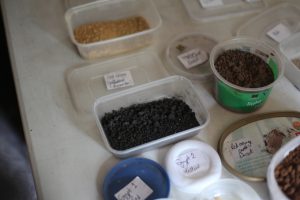
K: I made a decision not to take potentially harmful chemicals out into the land. Deciding to work with the materials present helped me focus on the substance of what I was seeing rather than setting out to achieve a likeness. I had witnessed in the realm of Landscape painting a dominance, to ‘conquer’ the landscape, to ‘capture’ the image, to ‘stake’ the easel- and I didn’t want to work in that way. So now I only take unprimed canvas out, a sketchbook and graphite sticks, this frees me up to record and experience more.

L: Soil has many associations with being dirty and unhygienic, yet it is also seen as fertile. How do you interpret these associations?
K: I don’t see it as being dirty. It is what has gone before, providing fertile ground for life and future life. It is our history and food for future and helps me ground myself and focus. Every future plant, and food for us to eat, comes from the soil.
L: Has your choice of medium ever been seen as controversial?
K: People have misunderstood the process but never really seen it as controversial. Once a friend had come to help me bring heavy aged canvases back from a Moor and he turned up with a shovel in case it was helpful. This angered a local who misunderstood this to be us digging through the peat bogs. I have been accused of making adult mud pies or doing work a cave man could do but both really misunderstood the processes behind the work.
L: What inspires you as an artist?
K: Anselm Kiefer, Joan Eardley, Kurt Jackson and Shani Rhys James from a painting perspective. During my student years I was quite influenced by the land art movement; Richard Long, Chris Drury, David Nash, Andy Goldsworthy with his endless patience. But then I wanted to translate that dialogue into a 2 dimensional language to take it into the realm of the painter.
L: Have you ever been involved in any community projects working as an artist?
K: Yes! I was a founding member of the Elements Festival, a small festival in the Midlands geared to take art, creativity and performance to typical places of fear across the community. One example of these areas is a big underground subway network, a place where people would feel vulnerable walking through after 4pm. We purposely set out with artists to make work in these spaces, to go against the White Cube gallery space that the public may feel excluded from, and also so they don’t have to change the course of their day to witness and be part of it.
L: Do you have any future projects in mind?
K: Through the last exhibition ‘Echoes of a Spiritual Nature’ we formed the Echo collective. Though we’re all artists from different disciplines, we support each other as much as we can. So the next show is focused on spoken word to correspond with the international poetry festival ‘100 thousand poets’, the 1st half will be poetry and the 2nd half will be a performance. My artwork will be used as Theatre, to set the stage for the performance to happen.
L: And Finally, what advice can you give young artists at the beginning of their career?
K: Do not surrender what’s important to you- follow that thread, it’s authentic and it’s the only thing you’ve got, it’s your voice!
No Comments